Twelve Questions to Ask Before You Let Anyone Cut
A short script for the quote conversation. The answers tell you more than the price does.
4 min read
You do not need to become an expert to hire well. You need a handful of questions whose answers are hard to fake, and the willingness to walk away when they land badly. Here is the script.
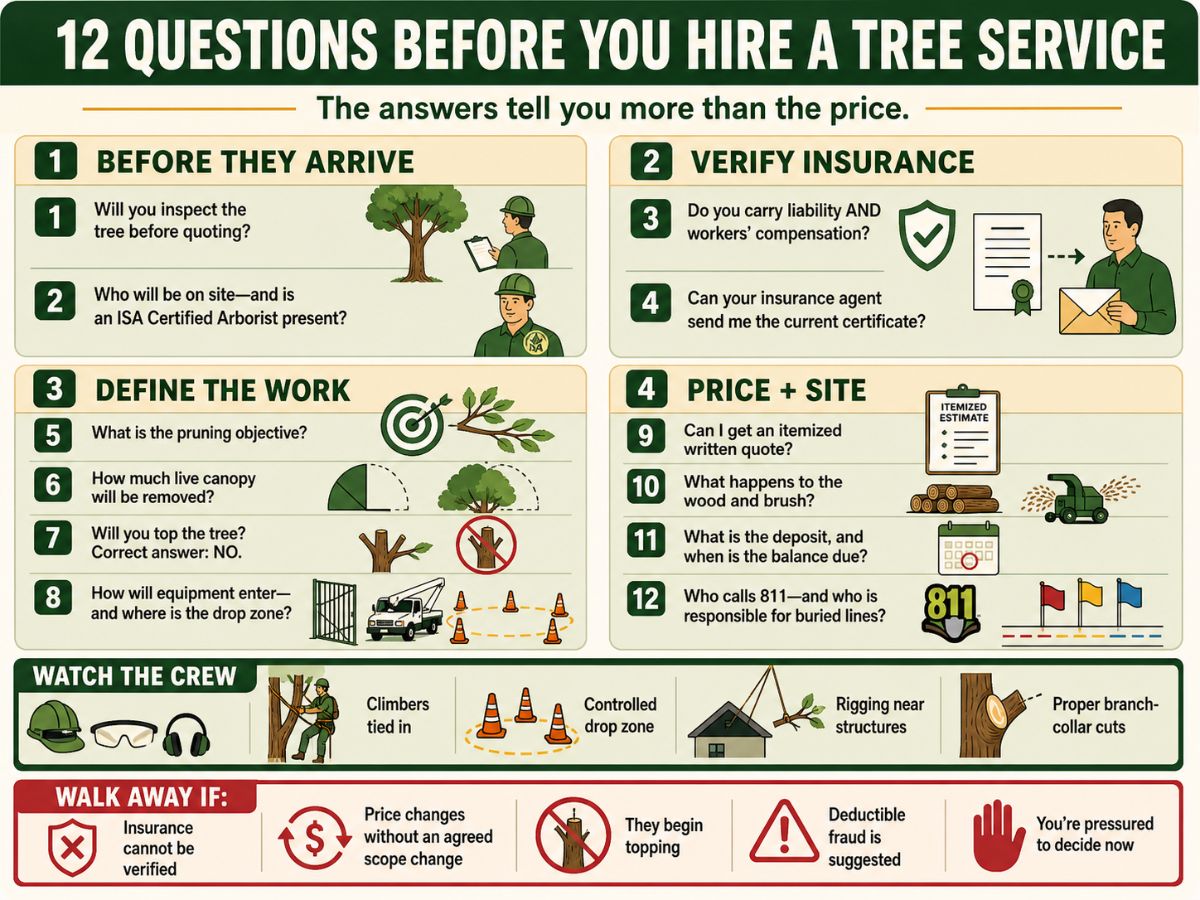
Before they arrive
1. Will you come and look at the tree before quoting?
A firm price over the phone for a job nobody has seen is not a quote, it is a placeholder — and it will change. Anyone who intends to do the work properly wants to see the access, the drop zone and what is underneath.
2. Who will actually be on site, and does anyone on the crew hold an ISA certification?
Certification attaches to a person, not a company. The useful version of this question is whether the certified individual will be present, or whether their name is on the letterhead while somebody else runs the job.
About insurance
3. Do you carry both general liability and workers' compensation?
Both. They cover completely different disasters — damage to your property, and injury to their people.
4. Can your insurance agent send the certificate directly to me?
This is the question that does the work. A contractor-supplied PDF proves a policy existed once. A certificate sent by the agent, naming you as certificate holder, proves it is current. Asking is routine and no legitimate company minds.
About the work itself
5. What exactly is the objective of the pruning?
You want to hear specifics — crown cleaning, reduction for end-weight, clearance from the roof. "Cut it back", "shape it up" and "thin it out" are not objectives. A company that answers in the language of ANSI A300 is working from a standard.
6. How much of the live canopy will you remove?
Anything above roughly a quarter in a single season is aggressive for a mature tree, and needs justifying. If the answer is a large fraction, ask why.
7. Will you be topping the tree?
The correct answer is no, with a bit of an edge to it. A contractor who offers topping as a service has told you what standard they work to. See trim or remove for why.
8. How will you get equipment in, and where will the drop zone be?
Practical, and revealing. It shows whether they have thought about the job, and it surfaces the lawn damage and access constraints that turn into arguments later.
About the money
9. Can I have it in writing, itemised?
Felling, debris removal and disposal, stump grinding and to what depth, removal of the grindings, backfill, permits. Each as its own line. This is the single best defence against a final invoice that does not match expectations — see what tree removal costs.
10. What happens to the wood and the brush?
Hauled away, left as rounds for firewood, chipped and left on site? All are legitimate and all are different prices.
11. What is the deposit, and when is the balance due?
A modest deposit for scheduling is normal. A large cash deposit before any work has started is not, particularly from a company you did not seek out.
About the site
12. Have you called 811, and who is responsible if a line is struck?
Relevant to any stump grinding or excavation. Line location is free, legally required in most places, and shallow service runs are well within reach of a grinder. See stump grinding vs removal.
What to watch on the day
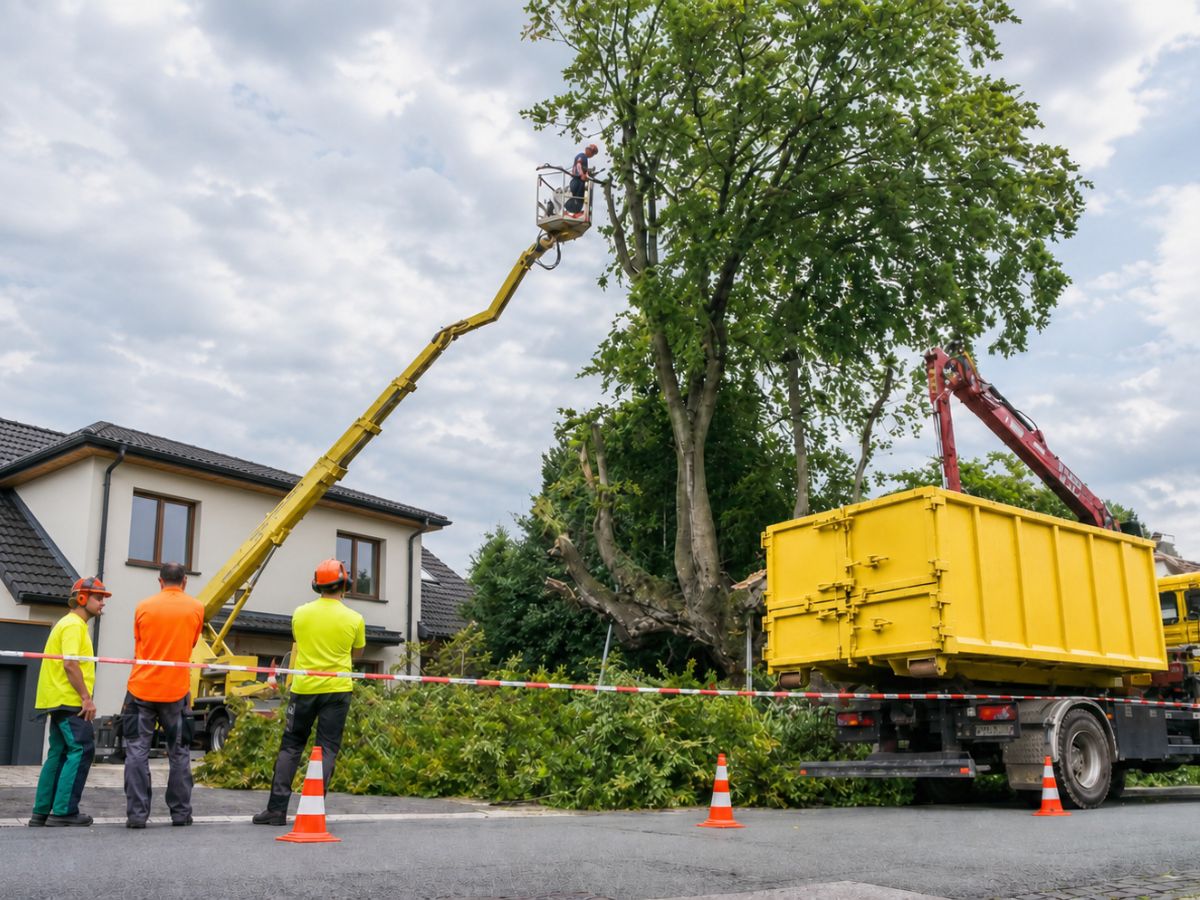
The questions get you a good contractor. Watching the crew tells you whether you got what you paid for:
- Helmets with chin straps, eye protection, hearing protection
- Climbers tied in on two points, working from ropes and saddle or a bucket — not from a ladder with a running chainsaw
- A defined drop zone with someone controlling it, and nobody standing under a limb being cut
- Rigging used to lower sections near structures rather than free-dropping them
- Cuts made at the branch collar, not flush to the trunk and not leaving long stubs
Walking away
You are allowed to stop the process at any point, including after a crew has arrived. The situations that justify it:
- Insurance cannot be verified with the insurer
- The price changes materially once work has begun, without a change in scope you agreed to
- They begin topping a tree after telling you they would not
- Anyone offers to help you avoid your insurance deductible — that is fraud, and it would be your claim
- Aggressive pressure to decide immediately
The tree has been there for decades. It can wait a day while you call someone else.