Stump Grinding vs Stump Removal — They Are Not the Same Job
Grinding shaves the stump below grade and leaves the roots. Full removal excavates the root plate. Which one you need depends entirely on what goes there next.
4 min read
These two get used interchangeably in conversation and quoted very differently on paper. The distinction is simple and it determines both the price and whether the result will work for what you are planning.
Grinding
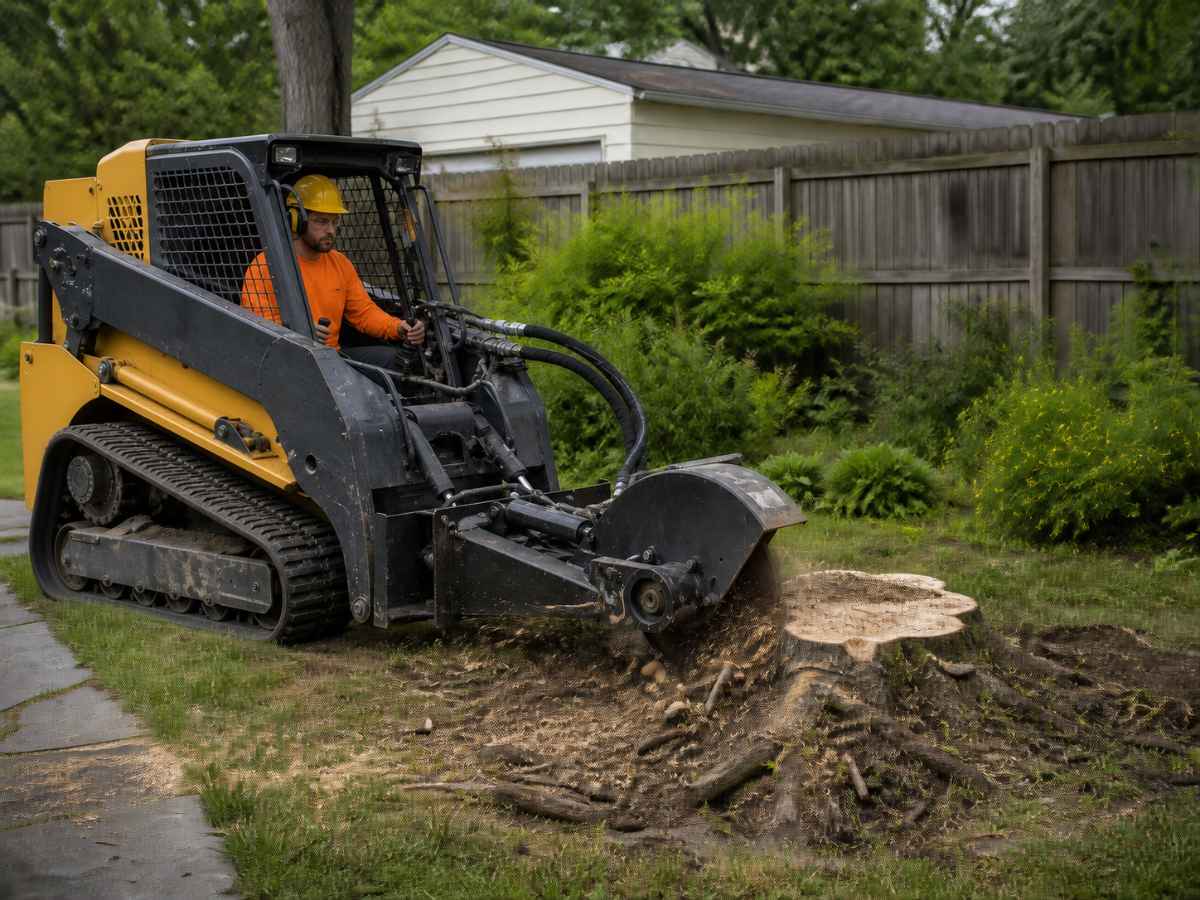
A grinder is a machine with a rotating cutting wheel that chews the stump into chips. The operator works down to somewhere around 4 to 12 inches below grade — deeper if asked, and deeper costs more.
What you get: no visible stump, a depression filled with a mound of wood chips, and the entire root system still in the ground, where it will decay slowly over years.
What it is good for: lawn, mulch beds, and general "make it go away" situations. It is faster, cheaper, and far less disruptive than excavation. For the large majority of residential stumps this is the right answer.
Full removal
Excavating the stump and the major root plate, usually with heavy equipment. You end up with a substantial hole requiring backfill, and significant disruption to everything around it — including, often, the lawn the machine drove across.
It costs considerably more and it is not usually necessary. But there are cases where grinding genuinely will not do:
- Building on the spot. Anything structural — a foundation, a slab, a footing — cannot sit over a decaying root mass, because as it rots the ground settles unevenly.
- Trenching or utility work through the root zone.
- Replanting a tree in the same location. More on this below.
- Certain root pathogens. Some root-rot fungi persist in the residual root system and can infect what you plant next.
The chips problem
Grinding produces a surprising volume of material — considerably more than the stump appears to contain, because the chips are not compacted. A large stump can generate a pile you would not want in the middle of a lawn.
Three questions to settle in the quote, because each is often a separate charge:
- Are the grindings hauled away, or left on site?
- Is the hole backfilled with topsoil?
- Are surface roots radiating from the stump ground out too, or only the stump itself?
Replanting in the same place
This is where people most often get caught out. Grinding removes the stump, not the roots, and a new tree planted directly on the old spot is trying to establish in a volume of soil that is mostly decaying wood — poor structure, unstable nitrogen, and eventual settling as the old roots break down.
Your options, roughly in order of cost:
- Shift the planting site a few feet. Cheapest and usually best.
- Grind deeper and wider than standard, remove the grindings, and backfill with quality soil.
- Excavate properly if the location is fixed and non-negotiable.
If the tree you removed died of a root disease, moving the planting site is not merely preferable — the pathogen may still be present in the residual roots.
What drives the price
Beyond the grinding-versus-excavation choice:
- Diameter at grade, which is the usual basis for pricing
- Access — a grinder that cannot get through a gate means a smaller walk-behind machine and more time, or hand work
- Depth requested
- Rocks, gravel and debris in the soil, which damage cutting teeth. Operators price cautiously around unknown soil, and a stump in a gravel bed may be quoted higher for good reason
- Buried utilities. Any responsible operator will want lines located before grinding near a service run. This is not padding — striking a gas line or a fibre drop is a serious incident
Grinding as part of a removal, or on its own
Plenty of operators specialise in stumps alone and are called in after another company has done the felling. That is a normal arrangement and often cheaper than having the removal crew do everything — though it means coordinating two visits.
If you are having a tree removed, check whether grinding is in the quote at all. It is one of the most common omissions and one of the most common sources of a bill that came in higher than expected — see what tree removal costs for the full breakdown of what should be itemised.