Nine Signs a Tree May Be About to Fail
Most trees that come down gave warning first. Here is what to look for, ranked from "call someone today" to "worth watching".
4 min read
Trees rarely fail without notice. The signals are usually visible for months or years beforehand — they are just easy to miss if you do not know what you are looking at. This is a walk-around you can do yourself in ten minutes, twice a year.
Work from the ground up. Most catastrophic failures originate at the base.
Call someone today
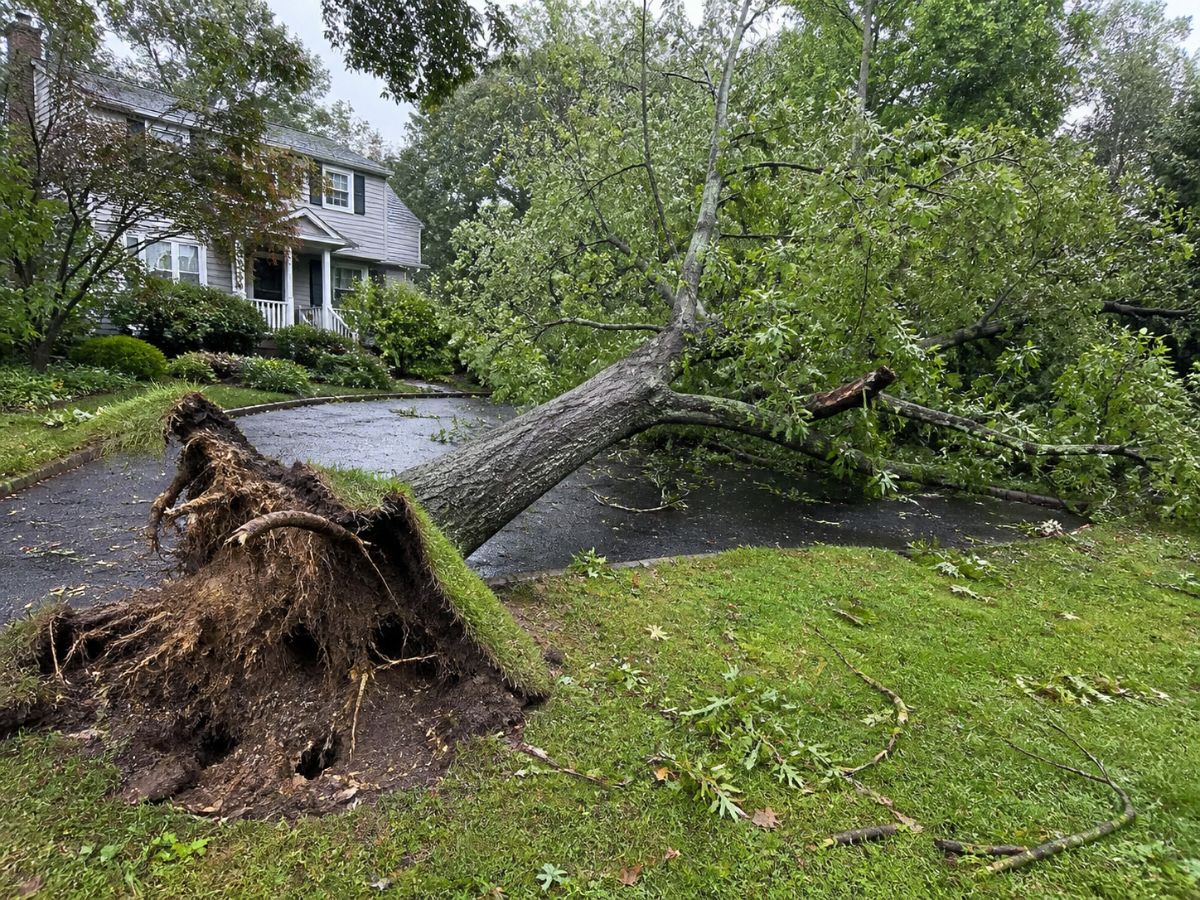
1. Soil heaving or cracking around the base. Look for the ground lifting on one side of the trunk, often opposite the direction of lean, sometimes with a visible crescent-shaped crack in the turf. This means the root plate is moving. The tree is already failing and it can come down in ordinary wind. Do not park under it, do not let children play under it, and get a professional out now.
2. A new lean, or a lean that is increasing. Trees that grew at an angle are usually fine — they have built reaction wood to compensate. A tree that has recently started leaning has not. If you can see fresh soil disturbance on the uphill side, treat it as sign 1.
3. A crack running through the trunk. Not bark fissures, which are normal and species-typical, but a crack you can put a finger into that appears to pass into the wood. Vertical cracks on opposite sides of the trunk are especially serious — that is a stem splitting.
4. Mushrooms or shelf fungi at the base or on the buttress roots. Fruiting bodies mean the decay is well established internally; the mushroom is the visible end of a process that has been running for a long time. Decay at the base is the most dangerous location because that is where bending loads are highest. Conks on the lower trunk of a large tree over a target deserve a prompt professional assessment.
Get it looked at soon
5. Deadwood in the upper canopy. Scattered small deadwood is normal. Large dead limbs, or dead branches concentrated at the top of the tree, suggest root or vascular problems. Crown dieback that starts at the top and works down is a classic root-system distress signal.
6. Codominant stems with included bark. Two trunks of similar diameter forming a tight V. Look into the union: if you see bark pinched between the stems rather than a raised, wrinkled ridge of proper wood, the two halves are not structurally joined — they are pressed against each other. These split, usually in a storm, usually when the tree is big enough for it to matter. Often cabling can address this if caught early.
7. Hanging or broken limbs still caught in the canopy. These will come down eventually and give no warning when they do. After any wind event, look up.
Worth watching
8. Girdling roots. A root circling the base and pressing against the trunk, often on trees that spent too long in a container before planting. Look for a trunk that goes into the ground like a telephone pole rather than flaring outward at the base — that missing flare is the tell. Slow-acting, but progressive.
9. Sudden changes in the surrounding soil. Construction, trenching, driveway work, grade changes, or heavy equipment parked over the root zone. Root damage and soil compaction take years to show up in the canopy, so a tree that declines mysteriously often points back to work done three or four years earlier. Grade changes that bury the root flare are particularly damaging and particularly common.
What raises the stakes
None of these signs mean much in isolation without knowing what is underneath. Arborists assess risk as the combination of how likely the tree is to fail, how likely it is to hit something, and how bad that would be.
A decayed tree in a back corner with nothing under it may reasonably be left alone and monitored. The same tree over a bedroom, a driveway where cars park, or a public sidewalk is a different decision entirely — and one that gets more urgent the more time people spend beneath it.
When to bring in a professional
Any of signs 1 through 4 warrant a call. So does any combination of the others on a large tree over something you care about.
Ask specifically for someone with the ISA Tree Risk Assessment Qualification (TRAQ). It is training in exactly this judgement, and it is a different skill from being able to take a tree down safely. Where the stakes are high, it is also worth getting that assessment from someone who is not bidding on the removal — see what the credentials mean.
If the assessment comes back marginal, trim or remove covers what can be mitigated and what cannot.